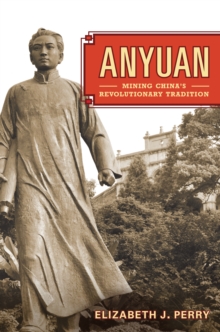
Anyuan : Mining China\'s Revolutionary Tradition
How do we explain the surprising trajectory of the Chinese Communist revolution? Why has it taken such a different route from its Russian prototype? An answer, Elizabeth Perry suggests, lies in the Chinese Communists\' creative development and deployment of cultural resources - during their revolutionary rise to power and afterwards. Skillful \"cultural positioning\" and \"cultural patronage,\" on the part of Mao Zedong, his comrades and successors, helped to construct a polity in which a once alien Communist system came to be accepted as familiarly \"Chinese.\" Perry traces this process through a case study of the Anyuan coal mine, a place where Mao and other early leaders of the Chinese Communist Party mobilized an influential labor movement at the beginning of their revolution, and whose history later became a touchstone of \"political correctness\" in the People\'s Republic of China.Once known as \"China\'s Little Moscow,\" Anyuan came over time to symbolize a distinctively Chinese revolutionary tradition. Yet the meanings of that tradition remain highly contested, as contemporary Chinese debate their revolutionary past in search of a new political future.
£26.95

Similar Deals

butterfly migration jigsaw
£13.99
From Stanfords

Futebol: The Brazilian Way of Life - Updated Edition
£9.99
From Stanfords

The Ordnance Survey Puzzle Book: Pit your wits against Britain` ...
£14.99
From Stanfords

Name That Movie: 100 Illustrated Movie Puzzles
£10.99
From Stanfords

The Princess Bride Talking Book
£7.99
From Stanfords

Desktop Curling: Hurry hard!
£9.99
From Stanfords

Mathematical Games Knowledge Cards
£7.99
From Stanfords

A Flight of Birds Knowledge Cards
£7.99
From Stanfords