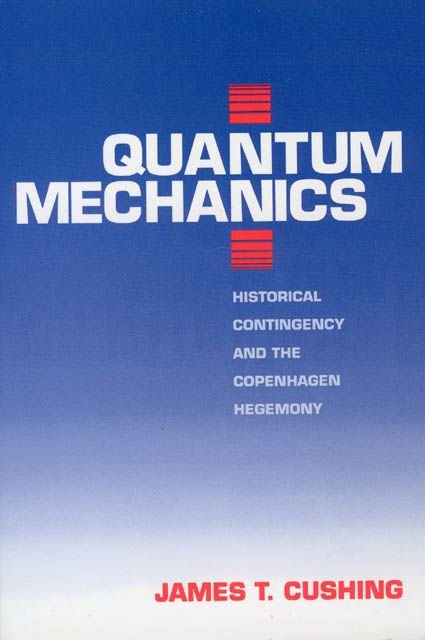
Quantum Mechanics
Why does one theory \"succeed\" while another, possibly equally clear and robust, fails? By exploring two observationally equivalent yet conceptually incompatible views of quantum mechanics, James T. Cushing shows how historical contingency can be crucial in determining a theory\'s construction and its position among competing views. Since the late 1920s, the theory formulated by Niels Bohr and his colleagues at Copenhagen has been the dominant interpretation of quantum mechanics. Yet an alternative interpretation, rooted in the work of Louis de Broglie in the early 1920s and reformulated and extended by David Bohm and his colleagues in the 1950s, explains the observational data equally well. Through a detailed historical and sociological study of the physicists who developed different theories of quantum mechanics, the debates within and between opposing camps, and the reception given each theory, Cushing shows that despite the preeminence of the Copenhagen view, the Bohm interpretation cannot be ignored. Cushing contends that the Copenhagen interpretation became widely accepted not because it is a better explanation of subatomic phenomena than Bohm\'s but because it happened to appear first. Focusing on the philosophical, social, and cultural forces that have shaped one of the most important developments in modern physics, this provocative book examines the role that timing can play in the establishment of theory and explanation.
£42.59

Similar Deals
Save 19%

Keto: A Woman\'s Guide and Cookbook: Volume 13
£17.99
£14.64
From Wordery
Save 2%

Clean Eating for Busy Families, revised and expanded
£12.99
£12.85
From Wordery
Save 25%
The Way of Tarot
£26.00
£19.74
From Wordery

Dichronauts
£11.99
From Wordery
Save 23%

Martin Parr
£30.00
£23.33
From Wordery
Save 1%

Knock Knock Money, Money, Money Receipt Catcher
£10.96
£10.94
From Wordery
Save 32%

The Lean Farm
£22.50
£15.48
From Wordery
Save 24%

Reset Your Child\'s Brain
£15.99
£12.18
From Wordery